

Have You Heard About the Companion George, May Allah Be Pleased With Him?
Sometimes, it is not the loudest moments that define us, but the quiet ones, the moments when a single decision changes the trajectory of our entire life. Such was the case for a man whose name is not often mentioned, yet whose story is one of the most powerful examples of transformation and redemption we can learn from. His name was George, and his story is forever etched in the history of Islam.
The year was 636 CE, and the great Battle of Yarmouk had unfolded between the Muslims and the Byzantine forces. The Muslim army, led by Khalid ibn al-Walid, may Allah be pleased with him, was vastly outnumbered, facing an army of 240,000 men with only 36,000 of their own. The odds seemed insurmountable, but the Muslims were driven by something far greater than the size of their forces. They were driven by a belief in something unshakable, an unwavering trust in Allah.
It was in the midst of this battle that George, a leader of the Byzantine forces, emerged. He came forward, ready for combat — but not in the way anyone expected. He called out to Khalid ibn al-Walid, asking for a moment of truth. In a voice full of seriousness, he said:
“Khalid, tell me the truth, for a free man does not lie. Is it true that God sent down a sword from the sky and placed it in your right hand, and that whenever you unsheathe it, you defeat your enemies?”
This was no ordinary challenge. It was a question born from a heart in search of something deeper — something that no sword could provide. It was a question about faith, about truth, about the unseen power that guided Khalid’s victories.
And Khalid, the “Sword of Allah,” responded with clarity and humility:
“No, but God sent a messenger to us who called us to noble morals and forbade us from doing bad. We disobeyed and fought against him. We differed with him until Allah guided our hearts to him, and we believed in him and confirmed his message.”
Can you imagine the weight of this moment? Here was a leader — a man who was about to face an opponent with immense power — offering a truth so simple yet so profound. Khalid didn’t answer with the pride of a warrior, but with the wisdom of one who had seen the light of Islam. He didn’t speak of swords or military strategies; he spoke of the guidance that had transformed his life and the lives of his companions.
George, still searching for the truth, asked another question:
“O Khalid, if I were to enter your religion, what would happen to me? What is in it for me, and what would I be liable for?”
It was a question that could have gone unanswered — a question that could have been met with political cunning or diplomatic games. But Khalid, with the purity of a heart guided by faith, responded:
“You would enter with a single word, the testimony of faith. You would have what we have, and you would be liable for what we are liable for.”
It was that simple. A single word — a simple declaration of faith — could change everything. No power, no wealth, no status could compare to the power of that one decision.
And George, his heart now fully open to the possibility, asked one final question that held the weight of eternity:
“If I pronounce the Shahada now, would I truly become one of you? Would I be accepted as one of your own?”
Khalid’s answer was clear, unwavering:
“Yes, you would be one of us. You would have what we have, and you would be responsible for what we are responsible for.”
And in that moment, George made the decision that would forever alter his life. He uttered the words of the Shahada:
“There is no god but Allah, and Muhammad is His Messenger.”
Imagine the relief that washed over his heart. The weight that lifted from his soul. The confusion that dissolved into clarity. He was no longer George the Roman warrior; he was now a believer in Allah, one of the Ummah of Muhammad (peace be upon him).
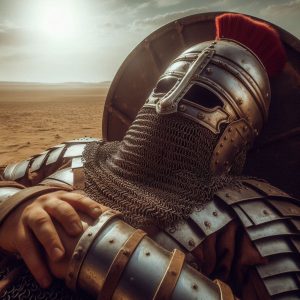 The battle resumed, but for George, the real fight had already been won. He fought valiantly alongside the Muslim army, his heart now aligned with the truth. But in the midst of that fierce battle, George was martyred. His story, like that of so many before and after him, was short yet powerful. He had entered Islam with sincerity, and Allah had rewarded him with the greatest honor — martyrdom in His cause.
When Khalid ibn al-Walid, may Allah be pleased with him, saw George fall, he raised his hands in praise and said,
“Glory be to Allah! A small deed and a great reward.”
George’s life had been a decision. A decision to leave behind everything he had known and embrace the truth. It was a decision to surrender to Allah, to follow the guidance of the Prophet Muhammad (peace be upon him), and to join the ranks of those who had pledged their allegiance to the Almighty.
The story of George is not just the story of one man’s conversion; it is a story about the power of decisions. The decisions we make today shape our tomorrow. George could have chosen differently. He could have walked away from Khalid’s invitation. But he didn’t. And in that single moment, his life was transformed forever.
As we reflect on George’s story, let us ask ourselves: What decisions are we making today? Are we choosing obedience to Allah, or are we letting the distractions of life cloud our judgment? Are we turning away from the truth, or are we opening our hearts to it?
George made the right decision. He embraced the truth, and in doing so, he changed the course of his life. He fought in the Battle of Yarmouk, was martyred, and found his eternal place in paradise. But his story serves as a reminder to all of us that every day is a new opportunity to make the right decision — to return to Allah, to embrace His guidance, and to live with sincerity in our hearts.
So, let us not delay. Let us make the right decision today, for we never know what tomorrow will bring. May Allah guide us all to make the choices that bring us closer to Him.